
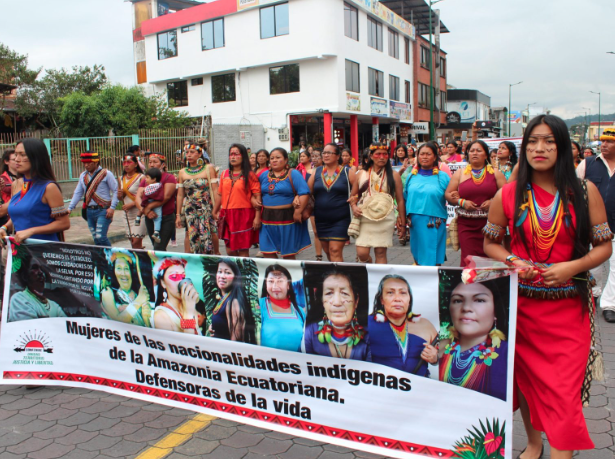
Amidst the struggles in defense of Indigenous peoples’ rights and territories, Amazonian Indigenous women have been at the forefront. In recent years, women throughout the Amazon have organized regional and national marches to ensure that their powerful voices and solutions are heard and addressed. Supporting these efforts is a key priority for Community Action Grants.
With the emergence of Amazonian women’s leadership, demands and solutions have become clear. Women are steadfast in their demands for a ban on industrial extraction within their territories. As a result, Amazonian Indigenous women have positioned themselves as critical stakeholders in local, national, and international spaces. Among their concerns are the defense of territory, the rights of women, nature, collective rights, education, health, culture, and climate change.
As governments and extractive industries have sought to open up rainforests and Indigenous territories of the Amazon region for decades, community-led grassroots organizing and advocacy have prevented the tendering of many planned oil blocks, with major victories being achieved by Indigenous communities through a series of mobilizations and legal strategies in recent years.
Two key Indigenous women-led networks supported by CAG are Mujeres Amazónicas and the National Articulation of Indigenous Women Warriors of Ancestry (ANMIGA).
Mujeres Amazónicas is an alliance of Indigenous women from several communities in the Ecuadorian Amazon that formed during a mobilization to Quito during International Women’s Day in 2018 and have continued to grow and build from that time, including holding events and mobilizations annually organized around International Women’s Day, which CAG has supported several times.
Highlights have included Mujeres Amazónicas launching the Casa de Mujeres Amazónicas, a new community center in the Amazon city of Puyo that serves as a safe space for women to retreat, connect, train, and receive support and organizing a 10-day series of activities themed around the impact of roads and the resulting deforestation on Indigenous communities, including trainings, forums, artistic activities, participation in marches, an exhibition fair, and organizing exchanges and intergenerational knowledge transmission.
The National Articulation of Indigenous Women Warriors of Ancestry (ANMIGA) in Brazil comprises Indigenous women from all six biomes in Brazil, reflecting their knowledge, traditions, and struggles to build solidarity and mobilize in advocating for Indigenous rights and the preservation of their ancestral lands. As Brazil has faced the dismantling of Indigenous and environmental policies, ANMIGA has been fighting for years for the demarcation of Indigenous lands and against mining and the leasing of their ancestral territories without their Free, Prior, and Informed Consent.
ANMIGA, having organized the Indigenous Women’s Marches and other major mobilizations in Brazil in recent years, has helped to position Indigenous women as critical stakeholders in local, national, and international spaces. During the 3rd Indigenous Women’s March, which had the theme of Defense of Biodiversity and Ancestral Roots, CAG funds contributed to the logistical costs of the mobilization and related activities, particularly supporting travel costs for Indigenous women via over 50 bus rentals, as well as providing specific support for delegations of Munduruku and Kayapó women.
That mobilization culminated with a historic march to the Brazilian Congress, where nearly 10,000 Indigenous women demanded that their rights be upheld and respected. A week later, Brazil’s Supreme Court blocked agribusiness-backed efforts to dramatically strip back Indigenous land rights, marking a historic victory in the ongoing fight to uphold Indigenous visions and solutions in their ancestral territories.